Showing posts with label Fossil. Show all posts

Tuesday, 24 May 2022

Holy Island pt 3


We have continued our exploration of Holy Island, using the excellent guidebook by John Bevan (2018 2nd Edition). I cannot recommend the book highly enough, it has drawn our eyes to the small details of the islands spiritual, industrial and cultural past. Details which we may have easily over-looked simply using the OS map for information. It has given us the waypoints by which to punctuate our walks around Holy Island.
Hobthrush AKA St Cuthbert's Island


One of the sites that we failed to explore, is the walk out at low tide to St Cuthbert's Island. Although I did spend probably an hour of each day, walking the main island's foreshore in front of it, looking for the enigmatic fossils known as St Cuthberts's Beads. The beads are the fossilised remains of Crinoids - from the Palaeozoic period, some 250 million years old.

At the end of these three days of fruitless searching, I am still content with the finding of some fossils in situ. still embedded in rock, near the Anglo-Saxon steading (see previous Blog entry).
Fossil-hunting


the Castle Staithes, and mooring eye


Bevan (ibid) tells us that the stiathes are the remains of the two wooden jetties which served the ships bringing coal to the Lime Kilns at the base of Lindisfarne Castle - and upon return transporting the quicklime to the mainland. Several iron mooring eyes also remain in situ, embedded in the rocky foreshore.
the Castle Staithes and mooring eyes

enjoying the crab sandwich
from the Post Office Cafe


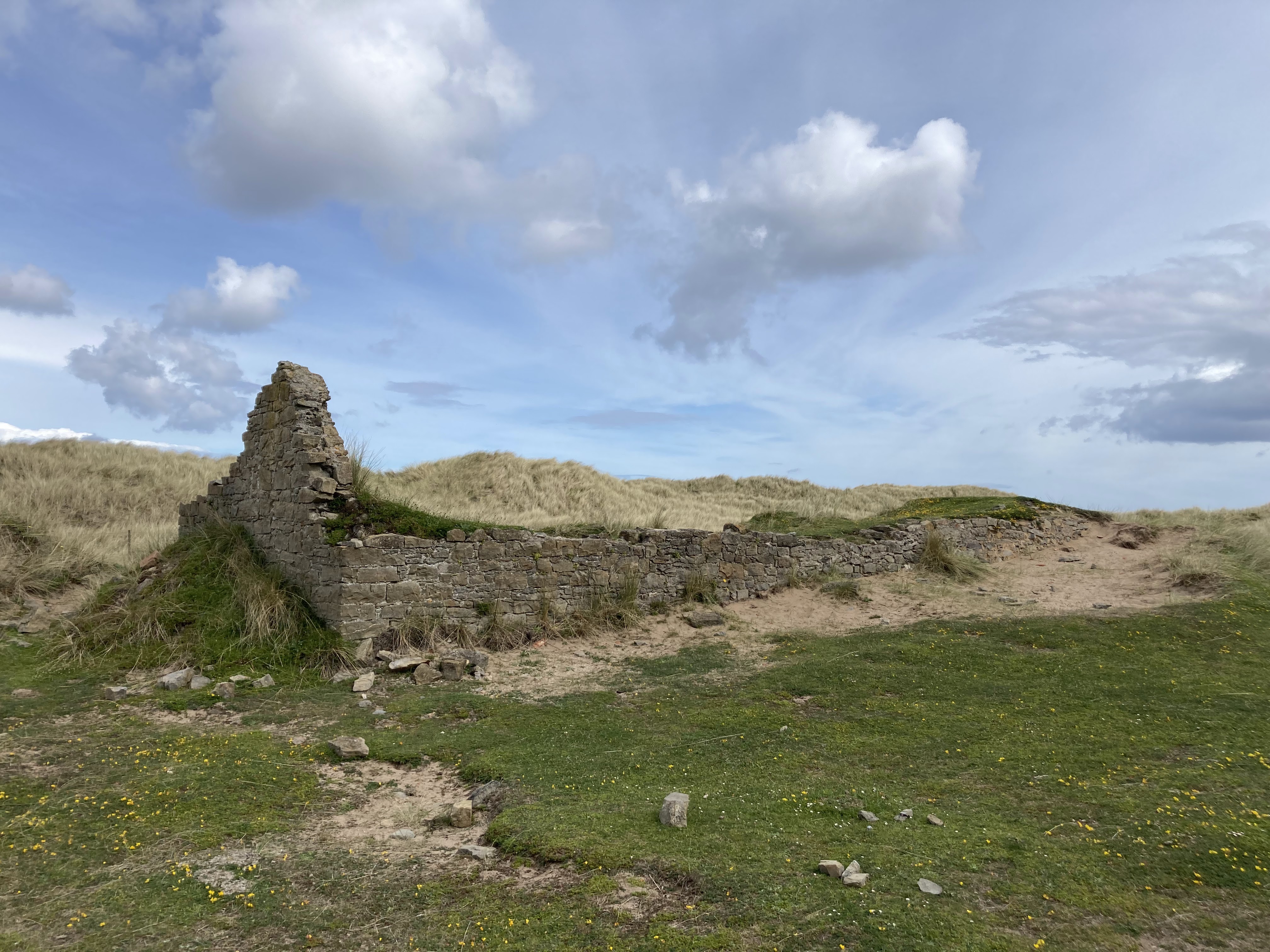
rems. Osborne's Fort
(built in the 1670's)

it would've been rude not to?


The joy of Holy Island, is there is still so much more to explore - so a third visit is already on the cards. We plan to hire a cottage for the week, and maybe go a little bit later in the season to get a better understanding of the dune system in flower? Watch this space.

Food and Drink

Monday, 23 May 2022

Holy Island pt 2

Our guidebook for the Island


Northern Marsh Orchid (Dactylorhiza purpurella)


Kennedy Lime Kilns

Common Butterwort (Pinguicula vulgaris)


The Sheil

tree stump

Northern Marsh Orchids

Sand Dunes


Greenshiel, rems. Anglo-Saxon steading  

St Cuthbert's Beads CRINOIDEA (250M years old)

the North Shore looking East


Limestone quarry, Ness End

Six-spot Burnet (Zygaena filipendulae) caterpillar


Piri Piri Burr (Acaena novae-zelandiae)
non-native invasive  species


Grey Seal (Halichoerus grypus)
Ness End and Castlehead Rocks


At Ness End we had a proper "wildlife moment" listening to the recumbant Grey Seals "singing" to each other across the open water. We have seen plenty of Grey Seals on our travels, but this was a first for us both. 


As we then proceeded around the island, we realised that it could be heard everywhere, being carried on the wind. Goosebumps!

Emanual Head, sentinel

The King's Bridge

Brig Well

Cuckoo Flower (Cardamine pratensis)

the Petting Stone
base of a Celtic Market Cross


Food and Drink

Our lunch was from the takeaway at:


Our evening meal was at:

Sunday, 27 July 2014

Fossil Forest. Lulworth


Just to the east of Lulworth Cove, through the gate to the army ranges and then south down steps on the cliff-side lies an exposed section of fossilised forest which has been dated to the Jurassic period, some 145 million years ago.

The holes in the circular fossil outcrops are known as "burrs" - and are the result of fossil hunters removing the fossilised wood itself (www.jurassiccoast.org 2001).

Having regularly travelled to Dorset and walked many miles of it's coastline and heathland over the past 20 years or so -this was a completely new site to explore after all these years.

Whilst we wandered amongst the fossil remains, a family group of rock pipit (Anthus petrosis) consisting four fledged but still downy young flying to shade and begging loudly of their hard-foraging parents.

On the calcareous grasslands above the site; and on the southern slopes of Bindon Hill - out of which fall the sea-carved cliffs of Lulworth Cove itself - we were able to connect with the local butterfly speciality - Lulworth skipper (Thymelicus acteon); along with 19 other species of butterfly including wall (Lasiommata megera), chalkhill blue (Polyommatus coridon), small blue (Cupido minimus), brown argus (Aricia agestis), silver-washed fritillary (Argynnis paphia) and dark-green fritillary (Argynnis aglaja); and a single clouded yellow (Colias croceus).

view along the fossilised forest route

herring gull (Larus argentatus)


the local speciality: Lulworth skipper

small blue

brown argus

chalk hill blue