Never ending or beginning on an ever spinning reel
As the images unwind, like the circles that you find
in the windmills of your mind"
Noel Harrison, Alan Bergman and Marilyn Bergman 1967
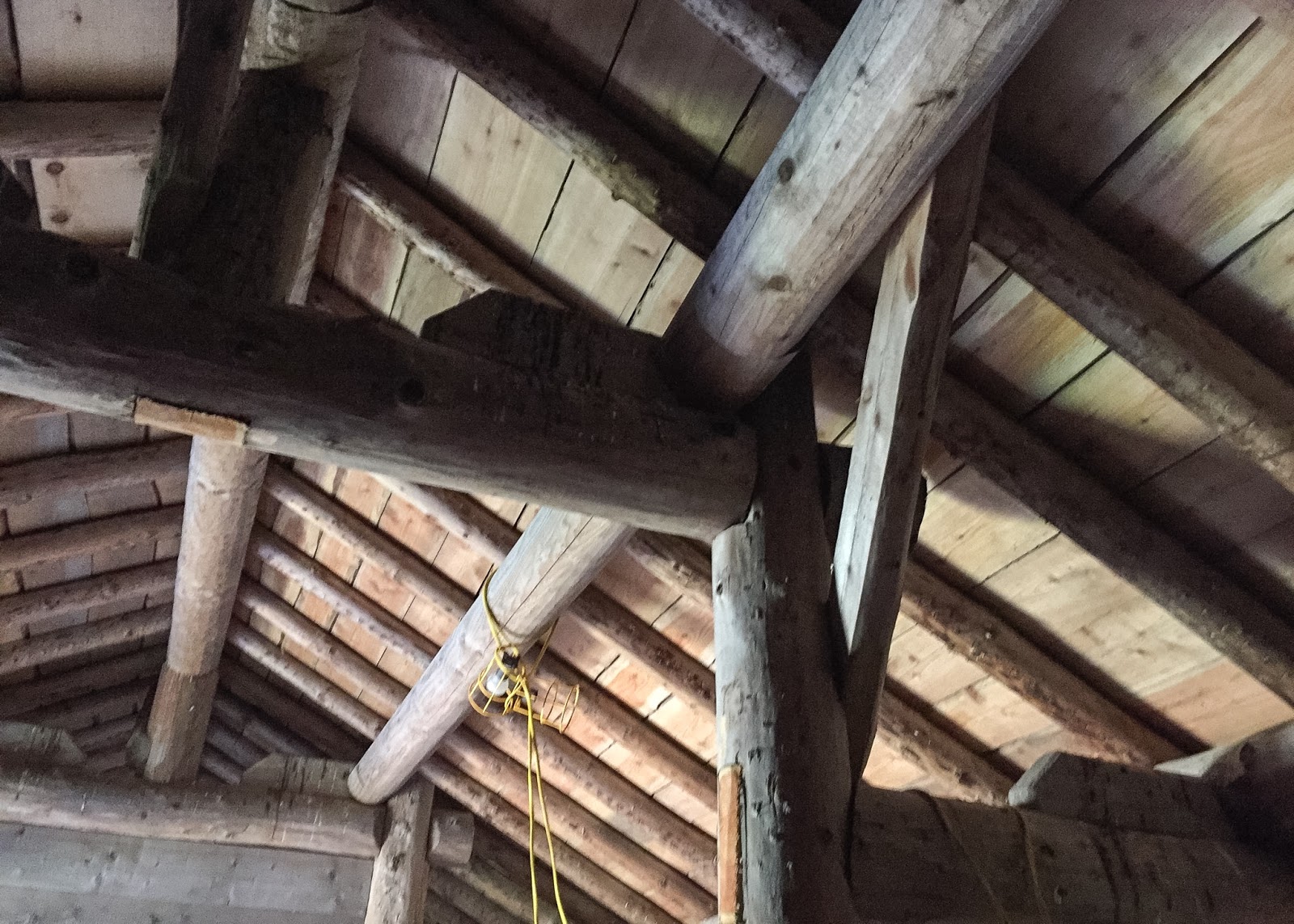
The most obvious historical feature that presents itself when climbing up Halnaker Hill is the windmill, Halnaker Windmill - it's recently restored red-tiled facade, brilliant white sweeps and beehive cap - all shiny and new against the skyline.
 |
| Halnaker Windmill |
The current windmill dates to the 1700's (Historic England 2019 [1]) - and replaces an earlier windmill built Ca. 1540 - the remains of which are visible to the south east of the newest building. The earlier being identified by a raised circular embankment with a deep central depression (Historic England 2019 [2])
 |
| Remains of 1540 windmill (circular embankment with central depression) |
Halnaker Hill is a chalk spur jutting out from the South Downs to the north, rising up from the coastal plain to the south. As such it provides an opportunity for 360deg panoramic views of the landscape surrounding it. To the north and west lie The Trundle and the Goodwood Estate. To the south and west one can cast an eye over Chichester Cathedral then beyond to both Chichester and Langstone Harbours - on a clear day the sunlight can be seen gleaming off the Spinnaker Tower in Portsmouth and the white cliffs of the Isle Of Wight. To the south and east the Rampion off-shore wind farm demands your attention.
However, to view only the windmill(s) and surrounding landscape - is to miss a much deeper history which inhabits the landscape, with archaeology spanning from the Neolithic to the thoroughly modern setting of WWII structures which can be seen across the wider hill top.
Before arriving at the top of the hill you have already followed an ancient way. The line of Stane Street, Roman Road - passes along the southern foot of the hill. The A285 partly follows this road - but at Mill Lane the "old" road in turn becomes a tree lined holloway. This sunken lane is worth a visit in it's own right - particularly when autumn colours adorn the trees.
 |
| Mill Lane - holloway following the line of Stane Street |
The lane provides both shelter and forage for a variety of common birds, incl. tits and winter thrushes. In spring and summer several warbler species and goldcrest (Regulus regulus) can be heard adding their song to the soundscape, in recent years this chorus has also included the firecrest (Regulus ignicapillus) (pers. obs.).
As you leave Mill Lane and turn north up the hill - you walk through an agricultural landscape of wide open arable fields and decrepit hedgerows providing cover for farmland birds such as linnet (Carduelis cannabina), yellowhammer (Emberiza citrinella) and skylark (Alauda arvensis) - joined in the winter by stonechat (Saxicola rubicola) and the occasional reed bunting (Emberiza schoeniclus). During spring and autumn migration you may be lucky enough to espy a wheatear (Oenanthe oenanthe) or whinchat (Saxicola rubetra) on passage (pers. obs.).
The gated entrance to the windmill stands in an opening between two banks - and these banks form part of the Halnaker Hill, Neolithic causewayed enclosure. This Neolithic ditch and bank earthwork encloses 2ha of the top of the hill (Historic England 2019 [2]). The southern part of the enclosure covering an area of approx 0.8ha is within Local Authority ownership and accessible to the public (West Sussex County Council 2019). The rest of the site is in private ownership.
Restricted access aside - it is the southern half of the site which boasts the most visible section of the earthworks - on its southern and south western side. The enclosure having been much flattened by modern ploughing (Historic England 2019 [2]).
 |
| Entrance looking south - showing embankment of causewayed enclusure |
 |
| sweep of embankment (with hedge) looking west from gate |
 |
| sweep of embankment (with hedge) looking east from gate |

 |
| two views of the western embankment looking north west & north |
Towards the south eastern side of the monument can be found an octagonal red-brick structure - which is open to the air - within the structure is a concrete footing.
This building dates from WWII and would have originally held a radio-direction finding system. The system was used to listen for and triangulate the direction of incoming enemy aeroplanes; the red brick structure being one of three similar buildings to be found on Halnaker Hill (Butler, C. 2008). This recent understanding of the WWII structures post dates the original Historic England (ibid) scheduling which lists them as "searchlight emplacements".


 |
| WWII radio-direction finding structure (Remains of) |
I recently saw a photograph of the WWII radio-direction finding installation on the Sussex Mills Group - Facebook page - the picture shows a wooden structure built within the red-brick walls - and to an untrained eye it would appear that the structures may have been constructed to deliberately camouflage the antenna to resemble windmills?
Facebook - Sussex Mills Group - Halnaker Windmill WWII archaeology
To the north east of the windmill - and discernible only after the grassland is cut in the autumn - is the remnant of a dew pond, dated to the 18th or 19th Century (Historic England [2] ibid) - a shallow hollow, which becomes quickly obscured as the spring grassland growth takes hold.
 |
| dew pond (Remains of) |
The chalk grassland on the West Sussex County Council owned site, is managed for wildflowers and bio-diversity (West Sussex County Council ibid). I have been involved with the wildlife monitoring on this site for a few years now, and would recommend a late spring visit for the show of cowslips (Primula veris), and as the summer progresses for the small collection of orchid species whose numbers have increased year on year (pers. obs.).
Common knapweed (Centaurea nigra) is a dominant flower within the grassland and it, along with the diversity of other wildflowers and grasses attracts a variety of butterflies and moths. I have personally recorded 19 species of butterfly using the grassland incl. marbled white (Melanargia galathe), small copper (Lycaena phlaeas), common blue (Polyommatus icarus) and large skipper (Ochlodes sylvanus). Only one butterfly species - the dark-green fritillary (Argynnis aglaja) has been noted on a single occasion only, the rest occurring almost annually (pers. obs.).
For such a small site - Halnaker Windmill is blessed with features to suit a diversity of interests with the archaeological remains, landscape experience, wildflowers, invertebrates and biodiversity. Needing just a short healthy walk up the hill in order to appreciate it. An all year round site to visit.
Bibliography
Butler, C. (2008) West Sussex Under Attack: Anti Invasion Sites 1500 -1990 The History Press, United Kingdom
Historic England (2019) [1] [Online] Halnaker Windmill Available at: https://historicengland.org.uk/listing/the-list/list-entry/1026409 Accessed 5th February 2019
Historic England (2019) [2] [Online] Causewayed enclosure, World War II searchlight emplacements and associated remains on Halnaker Hill Available at: https://historicengland.org.uk/listing/the-list/list-entry/1020514 Accessed 5th February 2019
West Sussex County Council (2019) [Online] Halnaker Windmill Available at: https://www.westsussex.gov.uk/leisure-recreation-and-community/places-to-visit-and-explore/halnaker-windmill/ Accessed 5th February 2019