Showing posts with label Merrivale ceremonial complex. Show all posts

Sunday, 13 November 2016

Merrivale Reprise

On our first visit to this Bronze Age ceremonial centre, we were ably defeated by driving rain and wind, which drained the energy from both ourselves, and the iPhone camera - costing us a hasty retreat, with a vow to return in better conditions.

For a full account of the rain-soaked visit, please refer to:

http://awalkamongstthestones.blogspot.co.uk/2014/12/merrivale-ceremonial-complex-dartmoor.html

Thankfully on the return visit we were blessed with blue skies and sunshine, giving us the opportunity to walk the double stone rows with dry ground beneath our feet; and explore the adjacent stone circle and its close-to standing stone.

<
Double stone row A

Julian Cope (1998) refers to Merrivale as the Plague Market in his gazetteer of megalithic Britain - so named because the plague victims of the 1600's banished to the moors - would be brought food at this place, by the healthy citizens. I have also found reference to this in the account by Legendary Dartmoor (2017) [Online] of the Bronze Age remains being referred to as Potato Market Or Plague Market citing William Crossing's Crossing's Guide to Dartmoor 1990 as historical reference.

Double stone row B

Cist

Merrivale stone circle
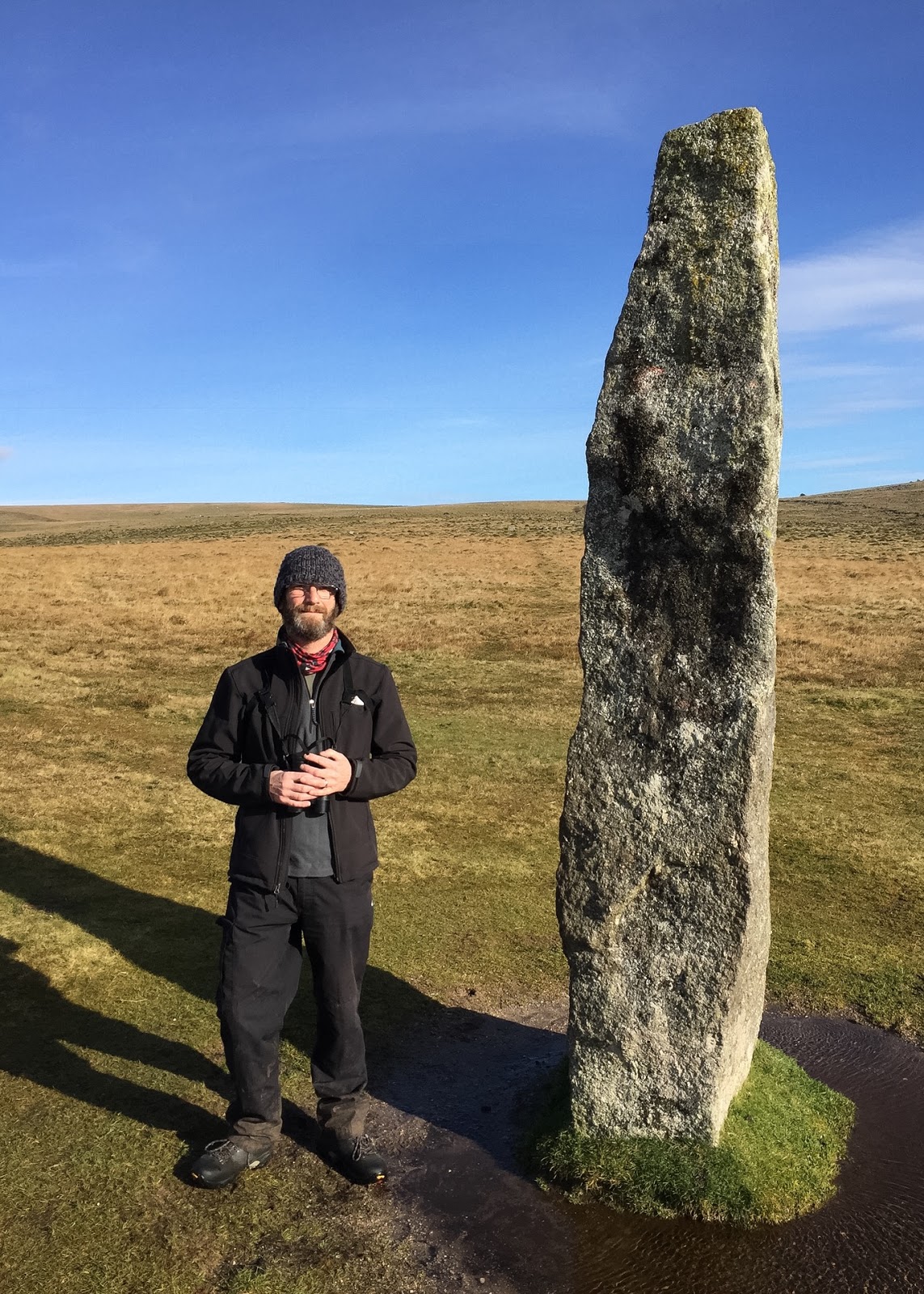
Merrivale Standing stone


Bibliography:

Cope, J. 1998 The Modern Antiquarian Thorsons, London

Legendary Dartmoor 2017 [Online] Merrivale Legendary Dartmoor

Tuesday, 14 October 2014

Merrivale ceremonial complex, Dartmoor - and a battered retreat

This ceremonial site consists of a variety of monument features including: a pair of parallel double stone rows running east-west, of which one contains a terminal cairn, and the second a central cairn; a single stone row, with terminal cairn; two associated cairns, a cist, a single standing stone, and a stone circle (Newman 2011). All of which sit immediately adjacent to a Bronze Age settlement. The ceremonial archaeology includes features which are associated with monuments from Neolithic to Middle Bronze Age Ca. 2500 - 1000 BC (English Heritage 2014).

On the day of our visit, the weather was horrendous, with stinging horizontal rain blasting in from the west. The peat below our feet was running like streams as we walked the stone rows.

Unfortunately, the power in the iPhone ran down completely part way through our exploration such that I have not been able to photograph all the archaeological features of this exciting landscape. Although in truth, our own power ran down too, and we hastily retreated to the Two Bridges Hotel nearby - for a restorative drink and a slice of cake. Resolved to revisit the site in better conditions!

 the northern double stone rows - looking east


continuing east through the northern
double stone rows
the southern double stone rows - looking west

continuing west through the southern
double stone rows


the central cairn within the southern double stone rows

cist with damaged cap stone

damaged cap stone detail N.B. chisel marks
where a local stone cutter, removed the  centre for a gatepost in 1860


Bibliography

English Heritage 2014 [Online], History and Research Merrivale Prehistoric Settlement, to be found at:

English Heritage Merrivale Pehistoric Settlement

Newman P. 2011, The Field Archaeology of Dartmoor, English Heritage, Swindon